New Harbor Street Official Opening
The Wife He Never Wanted: A Marriage-In-Crisis Billionaire Romance (Second Chance Billionaires)New Harbor Street Official Opening is the culminating public transformation of Harbor Street Shelter from a storm-damaged emergency site into a permanent, carefully designed refuge. Opening on a Saturday in October, the new building embodies the lessons of the collapse, the labor of evacuation, and a reconstruction process in which Paige Templeton and Claire—not Maddox Caldwell alone—determined what the shelter needed to become. Its walls, roof, rooms, and operating principles give physical form to a larger relational change: Maddox’s construction expertise is no longer a means of controlling the outcome, but a resource placed under the direction of the people who will live and work with its consequences.
Causes and Reconstruction
The opening is made necessary by the failure of the old Harbor Street building during a violent storm. The east end had been known to be vulnerable: Maddox had noticed the problem while sitting with Skipper in the dog’s kennel, but the recommended engineer had not been consulted because time and money were scarce. When the corner gave way, part of the intact wing fell with it, rain entered the main kennel room, and thirty animals had to be moved within an hour while flooding filled much of the county and emergency boarders and veterinary clinics were already full.
The emergency transfer turned structural failure into lived evidence. Claire and two volunteers hauled crates through ankle-deep runoff, while Paige helped move frightened dogs, yowling cats, and whimpering puppies through the soaked building. She stopped a border collie from escaping through the open wall, carried a senior cat in a pillowcase when the carriers ran out, and held a flashlight in her teeth while Claire coaxed a terrified pit bull away from the collapse as water rose over their boots. The old roof therefore becomes more than a damaged object: its absence exposes the cost of treating safety as an unaffordable luxury.
After the collapse, Maddox rejected the idea of simply replacing what had failed. He brought preliminary feasibility sketches, three possible sites, zoning and access notes, flood-plain data, and construction figures backed by the Caldwell name. Instead of presenting finished plans, however, he placed a largely blank Program Requirements template before Paige and Claire. The document asked them to specify intake capacity, an isolation ward, quiet rooms, and community space, establishing that the rebuilt shelter would be designed from operational knowledge rather than imposed as a completed gift.
Opening and Material Design
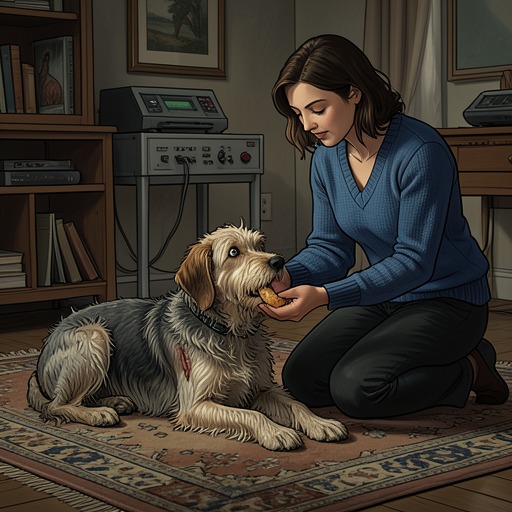
The new Harbor Street opened with Skipper as its first dog through the door. The choice is fitting because the old dog’s survival is tied to the shelter’s history and to Maddox’s change: Skipper had once remained in a damaged kennel, scarred and unadopted, until Maddox spent four shifts sitting with him on the concrete floor and took him home. At the new building, Skipper enters as though he owns the place, a comic but consequential image of an animal once treated as difficult becoming part of the institution’s founding memory.
Paige preserves that memory without freezing the shelter in its ruin. She places Skipper’s old torn ear, rendered as a small line drawing, on the logo above the intake wing. The mark is intentionally legible only to those who know the history: Paige knows, Claire knows, and Maddox knows while refilling the isolation ward’s water station. The logo turns an individual animal’s injury and unwanted status into a quiet emblem of recognition, not a spectacle.
The organization also retains its name. Harbor Street had lasted through two decades and one collapse, and Claire considers a name that survived the falling roof more valuable than a new name attached to a check. Paige agrees, and Maddox supports the decision without argument. The choice separates continuity from nostalgia: the institution keeps its identity while refusing to preserve the unsafe structure that once housed it.
The completed building realizes the requirements Claire articulated at the Templeton kitchen table. The isolation ward has its own air handling, the quarantine wing is a real dedicated facility, and the community room is large enough for indoor adoption events. Families move among animals beneath a roof that no longer requires anyone to pray when the sky darkens. The architecture answers the crisis concretely: containment, airflow, space, and weatherproofing become forms of care.
Authority, Partnership, and Ongoing Work
Maddox’s contribution matters because it is structured as a surrender of unilateral control. He tells Paige and Claire that he knows buildings but not shelters, while they know what every room and run must accomplish and what the old building never had enough space to provide. His commitment covers money, land, and crew, but they decide what gets built. Paige recognizes this as the opposite of his former method, in which he controlled every variable and entered negotiations with the answer already prepared. The blank page forces him to unlearn that method without turning the effort into a performance of sacrifice.
The opening confirms that the new arrangement remains active rather than ceremonial. When Paige points out that spring and baby season will require a larger cat room, Maddox has already left room in the east footprint for an extension. He agrees that the expansion can occur whenever she says, preserving her authority over both the timeline and the building while Claire remains the director. The future is thus designed into the structure, but its activation remains Paige’s call.
The shelter’s daily life also places the rebuilt marriage inside communal labor rather than apart from it. Paige stands with a clipboard she is not reading, then joins David Templeton over a drainage plan while Maddox follows and contributes his own view. Maddox does not need to close the moment with a speech; he stands beside Paige and lets the achievement exist. The couple’s partnership is expressed through participation in the next practical problem, not through a final claim of ownership.
Consequences and Significance
The opening converts disaster into a durable operating promise. The new Harbor Street offers refuge to animals who will pass through it for years, with walls that hold and a roof that is sound. Skipper sleeps in a patch of afternoon sun on the new concrete, his torn ear turned inside out, while the building continues around him. His unglamorous ease contrasts with the emergency’s frantic barking, rising water, and soaked volunteers, showing what successful reconstruction finally means: ordinary safety becoming possible.
The event also completes the shelter’s parallel with Paige Templeton and Maddox Caldwell’s marriage. The old building was a wet ruin; the new one arises from a blank page that Paige and Claire were allowed to shape. Maddox’s work supplies the foundation, but the relationship’s renewed solidity depends on his accepting limits, listening, and continuing to labor without an audience. The shelter therefore serves as both setting and material metaphor, though its practical functions remain primary: animal welfare, quarantine, adoption, and protection from the next storm.
By the end of the opening, Harbor Street no longer needs to explain why its roof matters. Paige has loved the old building for what it taught her, not for what it was, and its central lesson was that a roof and walls capable of holding are not small things. The new Harbor Street makes that lesson visible and repeatable. It preserves the shelter’s name, remembers Skipper, empowers Claire and Paige, and turns Maddox’s redemption into unobserved, continuing work rather than a single grand gesture.